
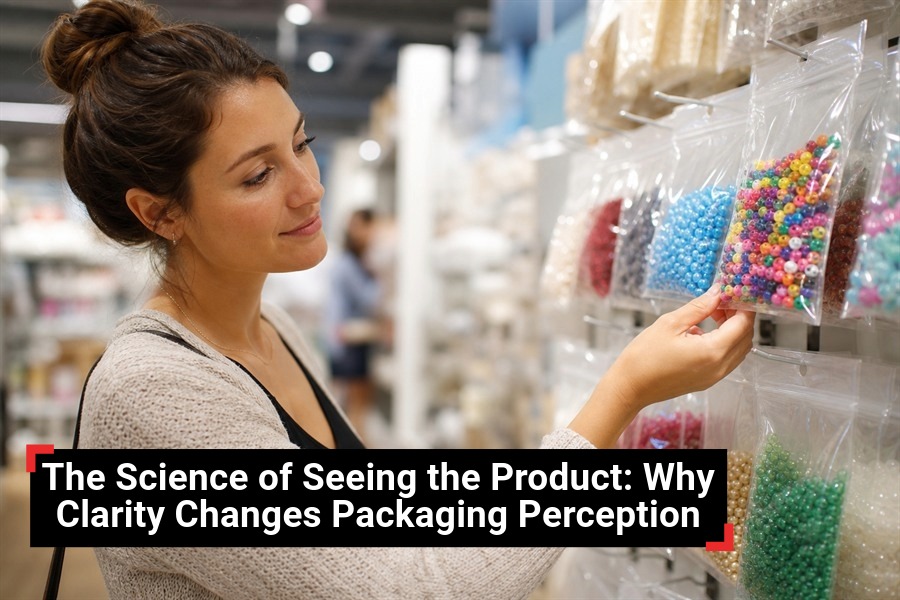
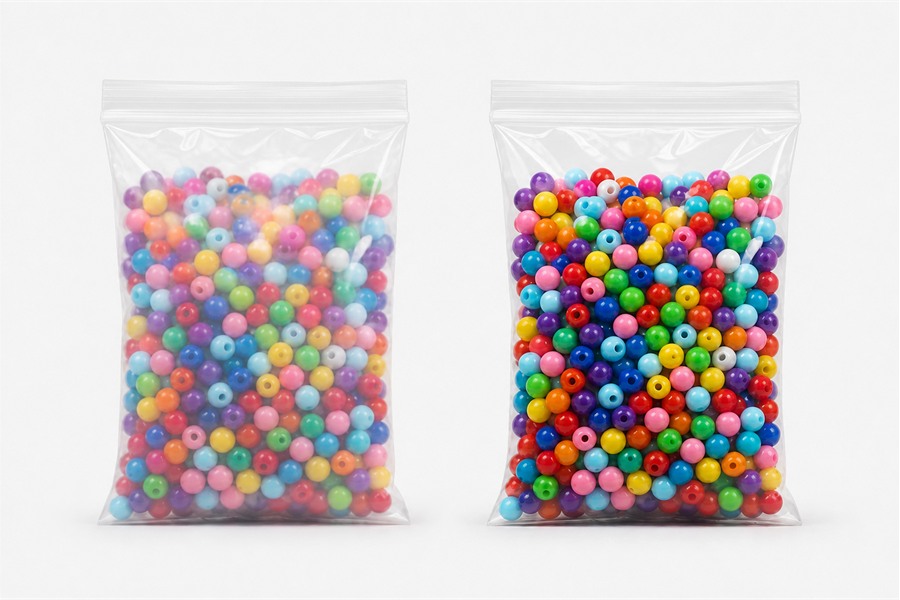
Clear is not a simple yes-or-no quality. Two plastic bags can both be transparent while presenting the same product very differently. One may preserve sharp edges, fine texture, and distinct colors. Another may soften those details with haze, surface distortion, or glare.
This difference matters because customers do not evaluate packaging and products separately. They see the product through the package. The film becomes part of the visual experience, influencing how easily someone can inspect color, shape, finish, condition, and small details.
The central idea: High clarity packaging does not improve the product itself. It reduces visual interference between the viewer and the product, allowing the product to communicate more of its own color, detail, texture, and quality.
What does high clarity actually mean?
In everyday packaging language, clarity describes how easily a person can see an object and its fine details through a film. A highly clear bag generally creates less visual interference, so edges remain defined and colors remain easier to distinguish.
However, clarity is not the same as transparency. A material can transmit a large amount of light and still look cloudy or make fine details difficult to resolve. Understanding the difference requires looking at several related optical properties.
Light transmission
What it describes How much incident light passes through the film.
What a viewer may notice A film can transmit substantial light without providing a sharp view of the product.
Haze
What it describes Light scattered through relatively wide angles as it passes through the material.
What a viewer may notice The film may look cloudy, milky, or washed out, especially over dark or colorful products.
Clarity
What it describes How well fine detail can be resolved through the film, including the effects of narrow-angle scattering and distortion.
What a viewer may notice Small text, texture, edges, and surface details may look sharp or slightly blurred.
Gloss
What it describes The appearance created by directional reflection from the film surface.
What a viewer may notice The package may look polished and reflective, although strong reflections can also create glare.
How light changes what customers see
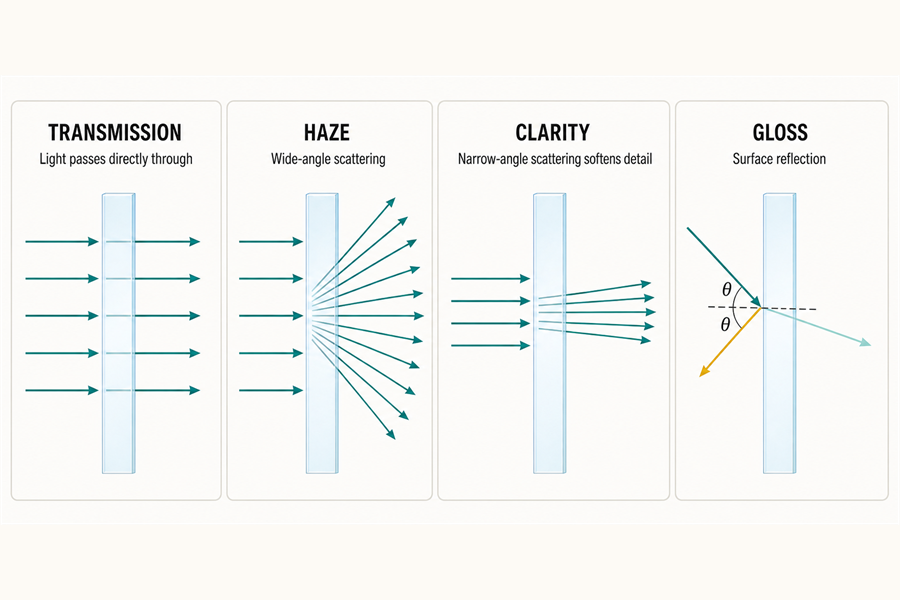
When light reaches a clear plastic film, several things can happen at once. Some light passes directly through. Some is scattered as it travels through the material. Some is reflected from the surface. The balance among these behaviors helps determine how the package looks.
Direct transmission preserves visibility
Light that passes through the film without significant scattering helps carry visual information from the product to the viewer. Color boundaries, printed details, textures, and edges remain easier to distinguish.
High transmission is useful, but it does not tell the whole story. If much of the transmitted light is scattered, the film may still appear hazy or make the product look soft.
Wide-angle scattering creates haze
Haze occurs when transmitted light is redirected over relatively wide angles. Instead of traveling along a predictable path, the light spreads out. This reduces contrast between neighboring details and can give the film a cloudy appearance.
Haze is often especially noticeable when a package contains dark, glossy, highly saturated, or finely detailed products. The product may still be visible, but its visual impact can be reduced.
Narrow-angle scattering softens detail
Light does not need to scatter widely to affect the image. Small changes in direction can make fine details look softer, even when the film does not appear obviously cloudy.
This is one reason two films with a generally clear appearance may perform differently when placed over small print, intricate textures, or products with sharply defined edges.
Surface reflection contributes to gloss
Some light reflects from the outer surface of the film. When that reflection is concentrated in a particular direction, the surface appears glossy. Gloss can create a clean, polished presentation, but it is not the same as clarity.
A highly glossy film can still have haze or distortion. It can also produce glare beneath strong lights. The most effective package is not necessarily the one with the most reflection. It is the one that maintains product visibility under the lighting and viewing angles where it will actually be used.
Why clarity can change color perception
A clear bag does not add color to the product. Instead, it influences how much of the product’s original color information reaches the viewer without being scattered, muted, or mixed with reflections.
Lower visual interference can make boundaries between colors easier to distinguish. Bright beads may look more distinct from one another. Printed graphics may appear more defined. Dark products may retain more visible surface detail instead of blending into a low-contrast mass.
This effect is particularly relevant for products sold partly through visual variety, including craft materials, decorative items, accessories, collectibles, hardware assortments, and other goods where color selection is important.
Important distinction: A high clarity bag should not be described as making a product inherently brighter, newer, or higher quality. It simply allows the customer to evaluate the product with less obstruction from the packaging.
Texture and small details influence confidence
Customers often use visible details as evidence. They may look for a smooth finish, consistent shape, clean edges, intact surfaces, matching colors, or the absence of visible damage.
When the film preserves those details, the shopper can inspect the product more easily. That inspection can support confidence because the package answers more questions before it is opened.
The effect depends on the product. A bag of plain fasteners may not need the same optical performance as decorative beads, printed stationery, polished components, or a product whose surface finish is a major part of its appeal.
Retail lighting can help or hurt visibility
Packaging is rarely viewed under perfect studio lighting. In a store, overhead fixtures create highlights that move as the shopper changes position. Shelving, neighboring products, and background colors can also affect contrast.
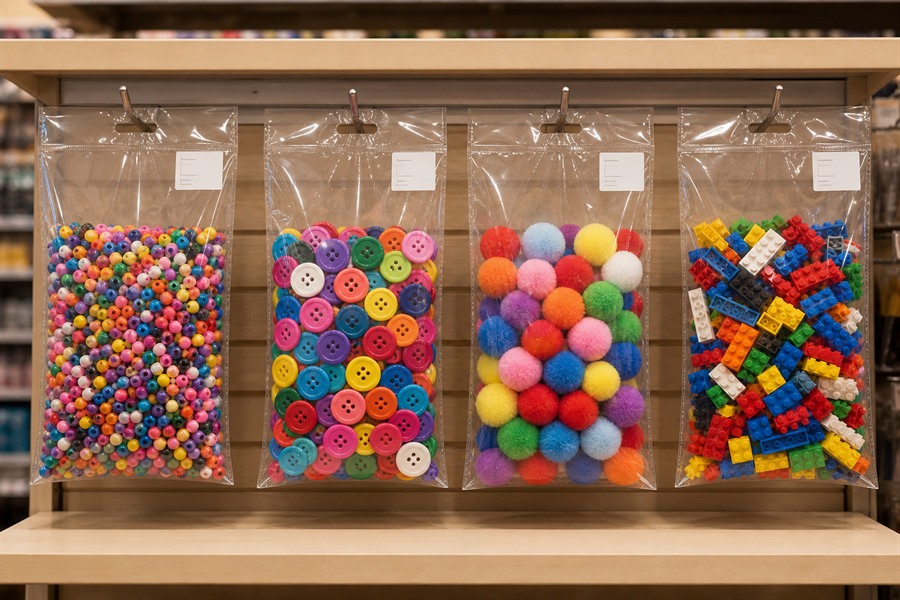
A film may look excellent when viewed straight on but develop distracting reflections at an angle. Wrinkles, curved surfaces, and excess empty film can create additional highlights. Labels can also block the very details the clear package was intended to reveal.
For these reasons, packaging should be evaluated under conditions that resemble the final environment. A quick shelf test is often more informative than examining an empty bag beneath office lighting.
How labels affect a clear package
Labels provide important information, but their size and placement can either support or compete with product visibility. A large opaque label placed across the center of the bag may eliminate much of the benefit of using clear film.
When practical, labels can be placed in an unfilled header area, near a corner, or on a portion of the package that does not cover a key product feature. The appropriate location depends on the bag shape, fill level, merchandising method, and information requirements.
Label adhesives should also be evaluated on the actual film. Appearance, adhesion, removability, and temperature performance can vary by label stock, adhesive, film surface, and storage environment.
The bag material and format still matter
Optical appearance is only one part of package selection. Film structure, thickness, stiffness, seal quality, closure type, durability, and product compatibility all affect performance.
Polypropylene bags are commonly considered when a crisp, clear retail presentation is important. Exact properties vary by film construction and bag specification, so samples should be evaluated with the intended product rather than assuming every polypropylene bag will look or perform the same.
Lip and tape bags can provide a neat closure for products that benefit from a clean presentation. The adhesive location, flap dimensions, bag fit, and expected opening or resealing behavior should be considered alongside clarity.
The term cello bags is used broadly in the packaging market. Depending on the supplier and product, it may refer to different clear film constructions rather than one universal material. If composition, food contact status, barrier performance, or disposal method matters, verify the actual specification instead of relying on the category name alone.
A practical five-minute visibility test
Packaging teams do not need a laboratory to identify many common presentation issues. A simple controlled comparison can reveal how a bag will behave in actual use.
- Use the real product. Fill each candidate bag to the expected level. Empty film does not behave exactly like film stretched, folded, or curved around a product.
- Keep the setup consistent. Compare bags under the same lighting, against the same background, and from the same viewing distance.
- Check more than one angle. View the package straight on and from both sides to identify glare, distortion, and changing reflections.
- Look at fine detail. Examine texture, edges, small print, color boundaries, and any feature customers are likely to inspect.
- Add the intended label. Confirm that the final label size and position do not obscure important product information.
- Handle the package. Look for wrinkles, scratches, fingerprints, static attraction, and other changes that may appear during packing or merchandising.
- Take a phone photo. If the product will be sold online, test how the package photographs under realistic lighting and whether reflections obscure the product.
Questions to ask before choosing a high clarity bag
When maximum clarity may not be the priority
High clarity is valuable when customers need to inspect the product, but it is not automatically the best choice for every application.
A translucent or opaque package may be preferable when light protection, privacy, concealment, branding area, or resistance to visible scuffing matters more than direct product visibility. Some products also require barrier, strength, or handling properties that should take priority over optical appearance.
The right question is not simply, “Which bag is clearest?” A more useful question is, “Which bag provides the right balance of visibility, protection, handling, closure, and presentation for this product?”
A note about the term “ultra high clarity”
Terms such as “high clarity,” “ultra clear,” and “crystal clear” are commonly used to describe visual appearance, but they do not necessarily represent one universal performance grade across every manufacturer or film type.
When optical performance is critical, request samples and compare them using the actual product. For more technical applications, review available specifications for properties such as haze, light transmission, film thickness, and surface gloss. Testing methods and results should be compared on a consistent basis.
Let the product do more of the communicating
Effective transparent packaging should make inspection easy. It should allow customers to see the product’s color, texture, shape, quantity, and condition without making them work around unnecessary haze, distortion, glare, or label coverage.
That is the practical value of clarity. It does not replace good product design, dependable protection, or accurate labeling. It simply reduces the visual distance between the product and the person evaluating it.
If you are comparing formats for a product that depends on visual presentation, explore Action Packaging’s selection of high clarity clear plastic bags. Reviewing the available bag styles, dimensions, closures, and film options can help narrow the choices before conducting a sample test with the actual product.